LinkedIn Tango

Fill the grid with suns and moons — balanced and unique.

3–7 minutesBy LinkedIn
linkedin.com/games/tango
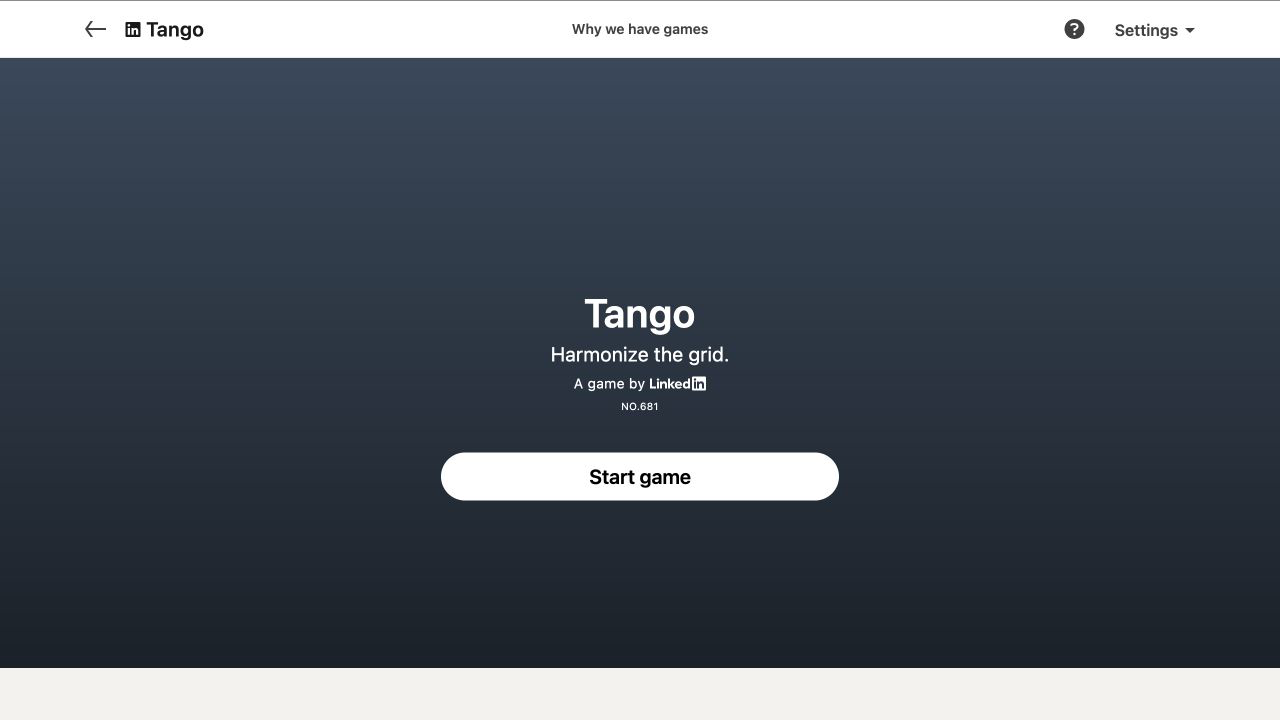
LinkedIn Tango official start screen
Official LinkedIn Games start screen, captured August 2026.

What is Tango?

Platform
Web
Access
Official LinkedIn link
Schedule
Daily at midnight PT
Session
3–7 minutes

Tango is a daily logic grid: fill every cell with a sun or a moon so that no more than two of the same touch, each row and column is balanced, and the = and × signs are respected. Every puzzle has one solution reachable by pure deduction.

LinkedIn Tango is a binary logic puzzle played with two symbols, usually suns and moons. Every cell must contain one symbol, each row and column must hold equal numbers of both, and no horizontal or vertical run may contain more than two identical symbols. Some neighbouring cells are linked by an equals sign, meaning they match, or an × sign, meaning they differ. The artwork may change on special boards, but the logical roles remain the same.

Because Tango uses only two values, every deduction has an opposite. Two suns can force moons; a completed moon quota can force suns; one side of an × link determines the other side. A good LinkedIn Tango strategy therefore comes from recognizing small patterns and propagating them accurately. This guide explains the stable rules, efficient scanning order, common mistakes, and score details without showing the current daily Tango solution.

Core rules

  1. 1Fill each cell with a sun or a moon.
  2. 2Keep equal numbers of each symbol in every row and column.
  3. 3Never place more than two identical symbols together; obey = and × clues.

Tango strategy guide

Master balance, three-in-a-row prevention, and equals or opposite signs in LinkedIn’s daily sun-and-moon logic grid.

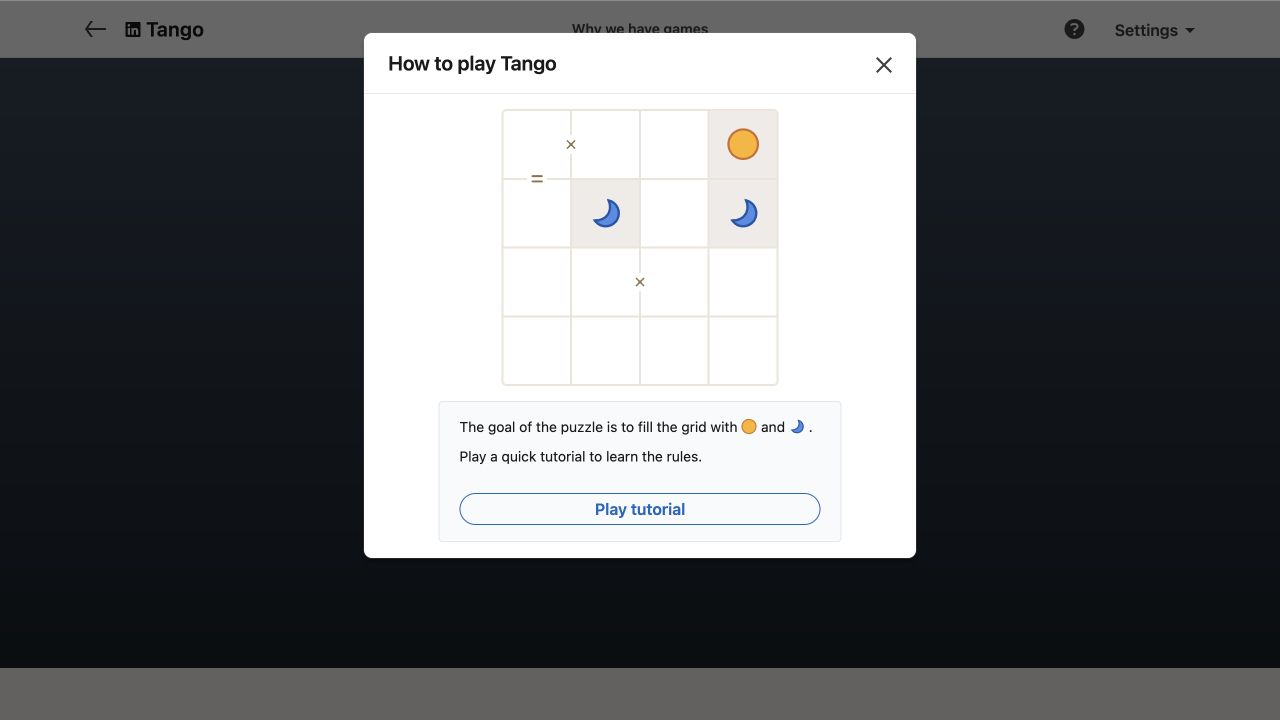
The official tutorial image shows the real game interface and an example puzzle, without revealing today's solution.

LinkedIn Tango official tutorial showing the real game board
Official LinkedIn gameplay tutorial
1

Learn the three basic line patterns

The easiest deduction appears when two identical symbols sit next to each other. A third matching symbol cannot extend that run, so any open cell immediately before or after the pair must be the opposite. The second pattern is a sandwich: if two matching symbols have one empty cell between them, the middle must be the opposite. These patterns work horizontally and vertically and should be your first full-board scan.

The third pattern comes from balance. On a six-cell row, once three suns are present, every remaining cell must be a moon; the reverse is also true. Count completed and potential symbols rather than waiting until only one cell remains. Pair rules and balance often combine: a forced moon may complete a sandwich in its column, which then forces a sun elsewhere. Tango’s satisfying chains usually begin with one of these elementary shapes.
2

Translate = and × into relationships

An equals sign links two adjacent cells with the same value. An × sign links them with opposite values. When one side is known, fill the other immediately and then check both affected lines. When neither side is known, the relationship is still useful: treat the pair as a unit. An equals pair consumes either two suns or two moons; an opposite pair contributes one of each to its row or column.

Chains of signs can carry information across the grid. If A equals B and B differs from C, then A differs from C. You do not need formal notation, but tracing the chain can unlock a section that appears empty. Be careful at corners where a cell participates in both a horizontal and vertical relationship. One correct placement may determine several linked cells, so update the complete chain before beginning a new guess.

3

Combine quotas with unresolved pairs

Harder Tango boards rarely give a single obvious cell. Instead, a row may contain a known opposite pair plus two fixed suns. Because the pair contributes one sun and one moon, you can calculate what the remaining cells must contain without resolving the pair. This accounting method is more reliable than mentally trying both alternatives and is especially effective where several signs cluster together.

Look at column quotas at the same time. If two cells in a row must be one sun and one moon, their columns may decide which order is possible. This is the binary equivalent of a locked pair in Sudoku. Mark the relationship mentally, inspect the crossing lines, and return with new information. Tango rewards moving between local patterns and global balance rather than finishing one row in isolation.

4

Develop a clean solving rhythm

Use a repeatable scan: adjacent doubles, sandwiches, completed quotas, sign links, then row-column interactions. After every placement, check the perpendicular line before moving on. A symbol forced by a horizontal rule may be far more important vertically. Random scanning wastes time because the same empty cells are reconsidered without new evidence.

LinkedIn provides Hint, Auto-check, Undo, and Clear controls. Auto-check can catch a rule violation, but it cannot replace the explanation for why a cell is correct. When a hint identifies a cell, inspect its row, column, and linked sign to find the deduction you missed. Keeping a flawless board is useful for the shared result, yet the lasting benefit comes from recognizing that pattern independently next time.

5

Measure improvement beyond speed

The Tango result may display solve time, the first five correct placements, and whether hints or mistakes occurred. Those first symbols describe your route through the board; they are not a hidden target sequence. A slower solve with a clear logical chain is better training than a fast solve built on accidental taps. Track where you pause: counting balance, reading signs, or spotting three-in-a-row patterns.

New puzzles arrive at midnight Pacific Time and previous boards expire. Difficulty can vary, so compare your process over several days rather than judging one time. If your goal is faster LinkedIn Tango solves, practice completing every consequence of a placement. Most lost time comes not from difficult logic but from overlooking a new double, sandwich, or quota created by the last move.

Common mistakes to avoid

These are rule misunderstandings and decision habits that create most avoidable errors.

Checking only rows

Every placement affects a row and a column. A valid horizontal pattern can still break vertical balance or create a triple.

Reading × as “not allowed”

The × sign means the two linked cells must be different; it does not mean either cell is blocked.

Waiting for a nearly full line

Unresolved equal and opposite pairs already contribute useful quota information before their exact order is known.

Allowing diagonal triples

Diagonal repeats are permitted. The no-three rule applies only horizontally and vertically.

Tango FAQ

Quick answers about rules, access, reset time, and score sharing.

How many suns and moons belong in each Tango row?

Each row and column contains equal numbers of the two symbols. On the standard six-cell grid, that means three suns and three moons in every line.

What do the signs in LinkedIn Tango mean?

Cells separated by = must contain the same symbol. Cells separated by × must contain different symbols. The rule applies to the two adjacent cells linked by that sign.

Can three matching symbols touch diagonally?

Yes. Tango prohibits runs of more than two identical symbols only in horizontal and vertical lines. Diagonal patterns do not violate that rule.

Why do Tango symbols sometimes look different?

LinkedIn notes that the emojis can vary on certain days. Regardless of the theme, the board still uses two distinct symbol types with the same balance and adjacency rules.

What information appears in a Tango score share?

The share can include solve time, the first five correct placements, and labels for no mistakes or no hints, depending on the assistance used.

Ready to play Tango?

Rules are checked against LinkedIn Help, and this guide never publishes today's clues, grid, path, or answer.

Spoiler-free by design